Circular Voices recording: Connecting Funding, Stories and Policy for a Circular Agri-Food Future Recap of the Circular Voices Online International Event

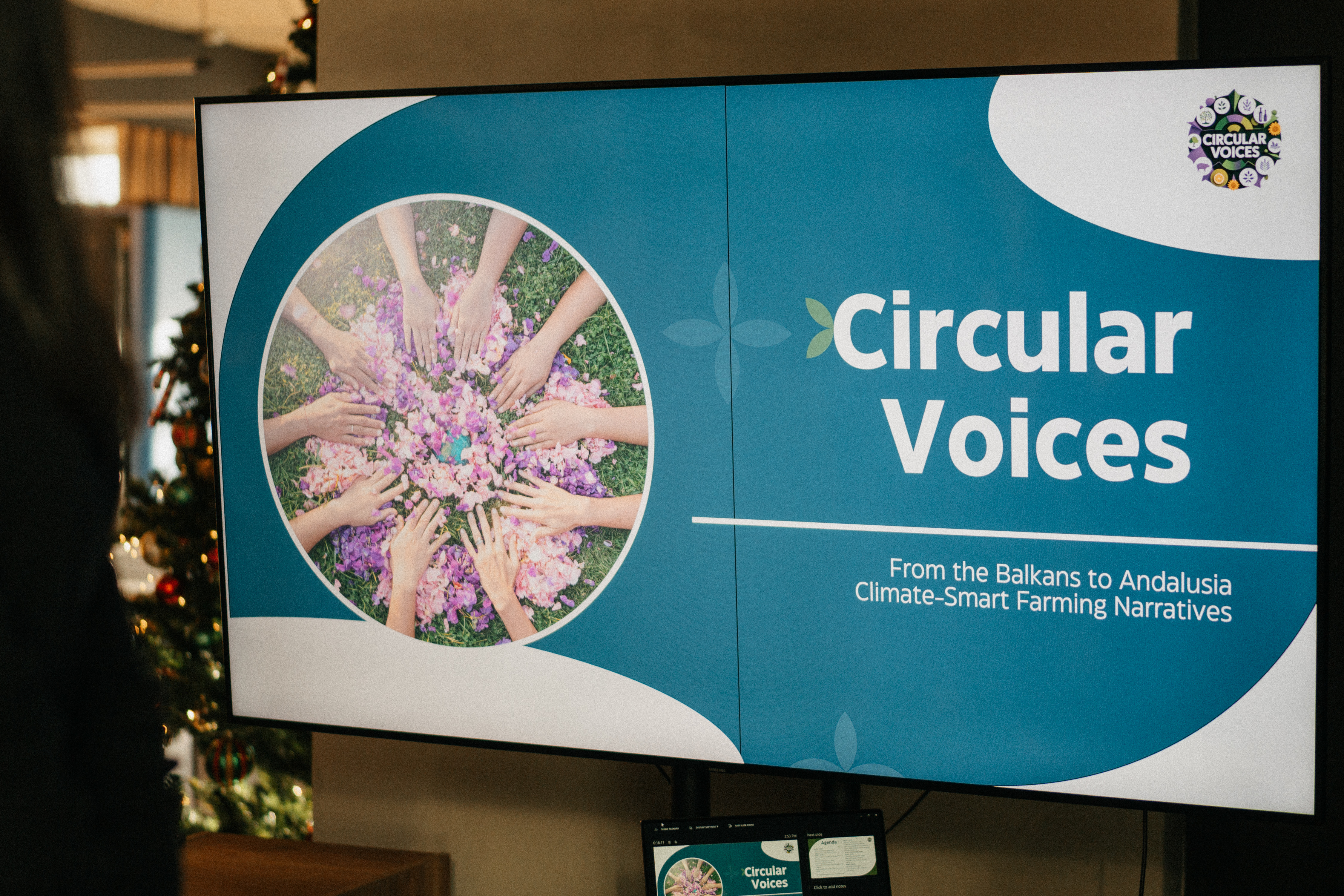
On 11 June, AgriVentures and Alberizas brought together an international audience of farmers, start-ups, researchers, investors and policymakers for the Circular Voices Online International Event. Organised with the support of the Circular Food Systems Network, the 95-minute session combined a look back at the Circular Voices project, a presentation of a new policy brief, an introduction to the pan-European TrueFoods project, a deep dive into EU cascade funding for SMEs, and a closing panel on what it really takes to scale circular innovation in the agri-food sector. Participants joined from Bulgaria, Spain, the Netherlands, Belgium, the United States and Africa, reflecting the increasingly global reach of the circularity conversation.
Two Organisations, One Shared Mission
The event was hosted by Dilyana Kutsarova of AgriVentures, who opened by introducing the two organisations behind Circular Voices. AgriVentures is a Bulgaria-based cluster organisation whose members span start-ups, investors, farmers, innovators and academia, with a particular focus on agri-food innovation in the Central and Eastern European region.
The cluster runs a testing programme that lets start-ups trial their innovations in real-world environments, organises capacity-building and networking activities, and recently launched a circular economy funding platform that gathers EU, global and private funding opportunities — accelerators, challenges and competitions — pre-filtered for relevance to the agri-food sector.
Sonsoles Jiménez then introduced Alberizas, a private entity with more than 15 years of experience in international project development across the agri-food value chain, from production and research to innovation. Together, the two organisations have spent the past months building Circular Voices, “our baby,” as Jiménez put it, with backing from the Circular Food Systems Network.
The Circular Food Systems Network: From Case Studies to a New Website
Flavia Casu, co-chair of the Circular Food Systems (CFS) Network, presented the network that sits behind the initiative. Established in 2021 under the Global Research Alliance on Agricultural Greenhouse Gases and initially funded by the Dutch Ministry of Agriculture, the CFS Network exists to advance food security while mitigating greenhouse gas emissions through circularity across the entire agri-food system — and to generate the evidence base policymakers need to design climate-smart, circular food systems.
In its early years, the network financed case studies on circularity from countries around the world to map the global state of play. A highlight has been the 2024 Circular Food Systems Summer School, which brought 20 young professionals to the Netherlands for two weeks of lectures, field trips and group work, each developing a case study on how circular principles could benefit the food system of their home region.
More recently, the network has launched a webinar series on the principles of the circular bioeconomy, financed the Circular Voices project, and is exploring the research-policy interface to translate its findings into concrete policy briefs. It is also preparing a side event at World Food Day in October 2025, planning a second summer school, and pursuing a role in a Global Research Alliance flagship initiative.
Casu closed by announcing the launch of the network’s new website and knowledge hub, cfsnetwork.org, where Circular Voices is now featured alongside the network’s other activities, contact details and newsletter sign-up.
Circular Voices: Making Circularity Visible and Relatable
Dilyana Kutsarova then walked attendees through the Circular Voices project itself. Its core purpose is to make circularity more visible and relatable by talking to the people already practising it. Through workshops in Bulgaria and Spain, the project team had honest conversations with farmers and companies about the challenges, benefits, pains and gains of circular practices — conversations that fed directly into a storytelling toolkit now available online.
The toolkit has two main components. The first is a self-assessment matrix covering ten areas, designed to help businesses see where they stand on circularity and where they can improve, paired with an action table of practical tips for embedding circularity into business strategy. The second is a collection of 16 short video stories — eight from Bulgaria and eight from Spain — in which farmers and businesses describe what they are doing and what circularity has brought them.
Several themes ran through these stories. Many participants, Kutsarova noted, were already applying excellent circular practices without recognising them as “circular” or capturing the market value of that positioning. Spain’s strong cooperative tradition was identified as a key enabler of large-scale circularity, in contrast to Bulgaria, where the absence of working cooperatives means scaling requires a different approach. A recurring insight was that once a business closes the loop, the system starts to work for itself — whether that is a high-tech greenhouse treating waste as a sign that something in its design needs fixing, or a seed producer who sees the seed not as the end of the loop but as its starting point. On the challenges side, participants pointed to heavy regulatory and reporting burdens, national funding mechanisms that can inadvertently reward the wrong practices, and the personal and family time that circular transitions demand — trade-offs that, they said, are repaid through customer loyalty, healthier soil and greater biodiversity.
A Policy Brief Aimed at the Next CAP
Maria Hristova presented the project’s policy brief, the fourth and final output of Circular Voices. Its starting point is the seven-year cycle of EU funding and the central role of the Common Agricultural Policy (CAP) in shaping how agriculture and quality are addressed. The brief analyses current EU data and flagship projects, highlighting that only around 12% of materials used in the EU economy are currently recirculated, leaving more than 80% dependent on primary, non-circular flows.
Hristova’s central concern is about the next programming period: national partnership plans will be designed at member-state level, and the ring-fenced CAP budget is earmarked for farmers — so it falls to each member state to ensure circularity is recognised as a national priority within that plan.
The Circular Voices team is therefore opening a signatory process to gather support from stakeholders across sectors, with the aim of feeding this message into the negotiation of the new CAP, which begins in under two years. Hristova also flagged that the Horizon Europe budget is set to rise to €175 billion in the next programming period, and that case-by-case collaboration with partners in the US and Africa on relevant calls is already happening and can be scaled further. Attendees will be notified by email once the signatory process opens, alongside links to the full policy brief and the Circular Voices toolkit.
TrueFoods: A New Pan-European Project on Post-Harvest Circularity
Jorge Milián-Gómez of the Free University of Brussels (VUB) introduced TrueFoods, a new pan-European project that kicked off in April 2025 and will run until February 2029, with AgriVentures as an associated partner. TrueFoods aims to transform European food systems around sustainability, equity, governance and resilience, focusing on the post-harvest stage of the food system and the environmental degradation, food loss and waste, resource inefficiency, governance fragmentation, social inequality and climate vulnerability found there.
The project’s pathway begins with legal, governance and policy analysis of the fragmented European approach to post-harvest food systems — covering both the current CAP, which runs until 2027, and its successor.
From there, a dedicated work package conducts life cycle assessments across a basket of products in the ten participating countries to identify inefficiencies and design circular economy strategies tailored to each context, validated through co-creation workshops with producers. A further work package, led with AgriVentures, focuses on inclusive business models and mentorship for SMEs, marginalised farmers and communities, while a transversal work package addresses resilience and adaptive governance. The consortium is led by VUB and includes partners from Romania, Italy, Germany, Sweden, Spain, Portugal and Bulgaria, alongside associated partners — including AgriVentures — contributing to dissemination, co-creation and mentorship activities across the network.
Cascade Funding: An Easier Entry Point to EU Money for SMEs
Nathalie Chavrier, Head of the Agri-Food Department and EU Funding at the Corporación Tecnológica de Andalucía (CTA) — a multi-sector innovation cluster of around 100 entities based in southern Spain and Brussels — gave an overview of cascade funding, also known as Financial Support to Third Parties (FSTP) or open calls.
Cascade funding is not a programme in its own right but a mechanism the European Commission embeds across many funding programmes. Large collaborative projects funded by the Commission commit to redistributing part of their budget to third parties outside the consortium through their own open calls. For SMEs — which make up around 90% of the agri-food sector — this offers a far simpler route into EU funding: grants are typically capped at €60,000 per beneficiary, application and reporting procedures are streamlined, and the process can serve as a stepping stone toward larger, conventional EU funding programmes later on.
Cascade calls appear within programmes such as Horizon Europe (particularly Cluster 6 and the Circular Bio-based Europe Joint Undertaking), the European Innovation Council Accelerator, Digital Europe, the Interregional Innovation Investment instrument and various Interreg programmes. By law, all open calls must be published for two months on the EU Funding & Tenders Portal, where they can be filtered by keyword; Chavrier also pointed attendees to national contact points (such as Spain’s Red PIDI) and the private portal Sloros for additional listings.
At the time of the webinar, four circularity- and bioeconomy-related calls were open: the Agri Bio Circular Hub, funding 12 start-ups from Poland, Latvia and Ukraine with around €50,000 each to scale sustainable agriculture and circular bioeconomy solutions (deadline end of July); a Bioeconomy bootcamp call funding travel and networking to attend a dedicated bootcamp (also end of July); the C4B call, funding pilot projects with bio-based business models (deadline 14 August); and a further call supporting innovative solutions for the transition to a circular economy (deadline 17 September). Chavrier encouraged interested SMEs to review the eligibility criteria carefully and to reach out to their national contact point or the relevant call coordinators for support.
The Scaling Panel: What’s Really Holding Circularity Back?
The event closed with a panel moderated by Sonsoles Jiménez, featuring Lorraine Allen, an innovation and commercialisation specialist working across food, agri-food technology and the bioeconomy; Mariano Oto, CEO and co-founder of the Spanish biotech company Núcat; and Lucía Díaz, Head of EU Programmes and Projects at the regional development agency of Andalusia and coordinator of its Enterprise Europe Network node. The opening question set the tone: is the real bottleneck to scaling circular innovation market readiness, policy, storytelling — or something more fundamental about how the system rewards the status quo?
Allen argued that technology and funding are not the constraint — market readiness is. Too many promising innovations focus on proving the technology rather than proving someone will buy it at scale, she said, and circularity needs to be built into the value proposition from day one rather than treated as a bonus once the science is done.
Oto agreed that the issue is value recognition. At the supermarket shelf, he said, consumers still choose first on taste and experience, then convenience, then price and brand, with health and sustainability further down the list — so circular solutions need to compete on those terms, not ask consumers to carry the sector’s sustainability burden alone.
He was candid about his scepticism toward both impact investors, who he said still chase short-term returns and exits, and politicians, citing a recently approved Eurostars project that the Spanish government declined to co-fund as evidence that circularity is not yet a political priority. His prescription: focus on small, concrete use cases — products that work on taste, price and convenience — as the realistic path to building trust with both consumers and investors.
Díaz offered a different diagnosis: the problem isn’t a lack of innovation, funding or demand, but that too many projects treat circularity as an isolated technical fix rather than a systemic, medium-to-long-term business transformation. Scaling, she argued, requires strong ecosystems built on real partnerships and support networks — and on funding access paired with advisory services, partnering support and market support.
On navigating the funding landscape itself, Díaz pointed to the Enterprise Europe Network, a free advisory service present in 60 countries that can help any company — regardless of where they are in their journey — find the right instrument, understand eligibility and make sense of cascade funding.
On branding, Allen noted that most customers don’t wake up looking for circular products — they’re looking for solutions to their own problems, whether that’s better performance, taste, nutrition or cost. The circular brands that succeed, she said, sell the outcome rather than the process: customers and B2B buyers alike want reassurance, performance and value, with the circularity story reinforcing trust once those core needs are met — not replacing them.
Asked for a single change that would accelerate circular innovation in agri-food, Díaz called for combined access to funding, advisory services, partnering and market support; Oto wants sustainability embedded in every purchasing decision, by consumers, companies and politicians alike, so the market itself rewards circularity; and Allen would make market validation and commercial readiness a non-negotiable part of every circular innovation project from the outset, rather than an afterthought.
The panel also addressed two audience questions. On the journey from research to market, Allen pointed to the value of strong commercial partnerships alongside scientific teams and to support structures such as EIT Food and university technology transfer offices, noting growing appetite from large food producers for new technologies as EU regulation reshapes supply chains.
Díaz added that the clean transition is itself forcing agri-food businesses to evolve their models, while Oto summarised the barriers to scale-up in four words: regulation, consumer perception, scaling difficulty and funding.
On engaging farmers, Hristova closed the discussion by stressing the importance of direct, honest, on-the-ground conversations — and of letting farmers see the results achieved by other farmers who have already made the shift, alongside continued investment in education on the principles and practical benefits of circularity.
Useful Links & Resources
• AgriVentures Circular Economy Funding Platform — circular.agriventures.co
• Circular Food Systems Network — cfsnetwork.org
• EU Funding & Tenders Portal (open calls, incl. cascade funding) — ec.europa.eu/info/funding-tenders/opportunities/portal
• Enterprise Europe Network (free funding & innovation advisory) — een.ec.europa.eu
Looking Ahead
Closing the session, Kutsarova thanked the CFS Network, Alberizas, TrueFoods and the panel speakers, describing Circular Voices as “a starting point” for a growing network of collaborators. The teams will continue collecting circularity case studies, are moving into new related projects, and will follow up by email with links to the Circular Voices toolkit, the policy brief and details of the upcoming signatory process. Attendees were encouraged to follow AgriVentures and the Circular Food Systems Network on LinkedIn and to subscribe to their newsletters to stay informed about future webinars, funding calls and opportunities to get involved.
The role of Agriventures in supporting agrifood innovation
As the agritech startup ecosystem grows across Europe, initiatives such as Agriventures are helping connect entrepreneurs, researchers, investors, and policymakers working in agriculture and food innovation.
Agriventures focuses on supporting agrifood startups, biotechnology innovation, and access to European funding for agriculture, while also helping entrepreneurs navigate the complex landscape of startup financing, venture capital, and research commercialization.
By strengthening connections between startups, research institutions, investors, and farmers, Agriventures contributes to building a stronger agricultural innovation ecosystem that can accelerate the transition toward sustainable agriculture and resilient food systems.
Through knowledge sharing, events, and ecosystem building, Agriventures helps ensure that promising agritech innovations can scale and reach farmers, food producers, and global markets.
Tags
Related Articles
Continue reading our latest insights and updates from the AgriVentures ecosystem.

Where Agrifood Biotech and Research Funding Is Actually Going in 2026
Basic research doesn't fund itself, and in agrifood, the gap between a promising lab result and a fundable project often comes down to knowing which of a dozen overlapping EU programmes to approach first. Food safety science, biotech platforms, and multi-country research consortia each follow their own funding logic, and 2026 has brought fresh calls across all three. Two Live Examples Worth Studying Safe-Agri, one of AgriVentures' active projects, is reinforcing the security assessment...

VerAgro launches a free self-assessment to help farms measure - and improve - their sustainability
"How sustainable is your farm?" It's a question most producers can answer instinctively, but rarely with hard numbers. A new Bulgarian startup wants to change that. VerAgro, a Bulgaria-based agtech startup, has launched a free online self-assessment that gives farms and processors a clear, structured picture of where they stand on sustainability — and what to do next. A 20-minute check-up for your farm The tool works like a health check-up for your operation. Farmers and processors answer 57...

A New Door Is Opening for Bulgarian Farmers and Agri-Innovators - And It's Fully Funded
For years, the biggest barrier between Bulgarian agriculture and Europe's most advanced farms hasn't been ambition. It's been access — to the right rooms, the right people, and the budget to get there. AgriVentures' new Missions program was built to remove exactly that barrier, and it does it in a way few programs in the region ever have: by covering the full cost of getting Bulgarian farmers, entrepreneurs, scientists, and companies in front of Europe's leading agri-food innovators. If you...

Inside projects.agriventures.co: Your Gateway to EU AgriFood Innovation
AgriVentures has launched projects.agriventures.co, a dedicated portal that brings the full portfolio of our EU-funded initiatives into one place. Where agriventures.co connects agrifood innovators with funding, the Projects site shows what happens next: the live programmes, Living Lab pilots, and network activity that funding makes possible. Here's what you'll find on the site — and how each part of our community can put it to work. A Live Portfolio of EU Projects The homepage opens with our...

Understanding Biomass Flows in Europe: A €6M Horizon Europe Call Agrifood Founders Shouldn't Miss
A question we've been getting a lot lately, including from our own LinkedIn community, is some version of: "Can my startup actually apply for this, and how?" This time it's about Understanding biomass flows in Europe (HORIZON-CL6-2026-01-CIRCBIO-05), a Horizon Europe call with a total budget of €6,000,000 that opened on 17 April 2026 and closes on 17 September 2026. It's exactly the kind of opportunity worth breaking down properly, because the honest answer is "yes, but not the way most...
SYSARM Launches Its Website: Discover Why Systems Thinking Is the Future of Farming
We are excited to announce the launch of the official SYSARM – Systems Thinking for Agricultural Risk Management website! 🌐 Visit us at: https://sysarm.eu/ As the project begins its journey, the website will become the central hub for news, project updates, learning resources, events, and insights into one of the most important concepts shaping the future of agriculture: systems thinking. What Is Systems Thinking? Agriculture has always been about managing uncertainty. Today, however,...
Never Miss an Update
Join our community to receive the latest insights, funding opportunities, and industry news from AgriVentures.