AI Won't Revolutionize Agriculture Without One Missing Ingredient: Better Data


Artificial intelligence is rapidly becoming one of the most transformative technologies in agriculture.
From predicting crop diseases and optimizing irrigation to automating field operations and improving supply chain efficiency, AI promises to help farmers make faster, smarter, and more sustainable decisions.
Yet despite the excitement surrounding the technology, one critical challenge remains largely overlooked: data quality.
According to a recent analysis by MIT Technology Review, agriculture is technically ready for AI—but its data infrastructure is not. While many agribusinesses are eager to adopt AI-powered tools, fragmented, inconsistent, and incomplete datasets continue to limit the technology's real-world impact. Rather than algorithms being the primary obstacle, the industry's biggest bottleneck is the information those algorithms rely on.
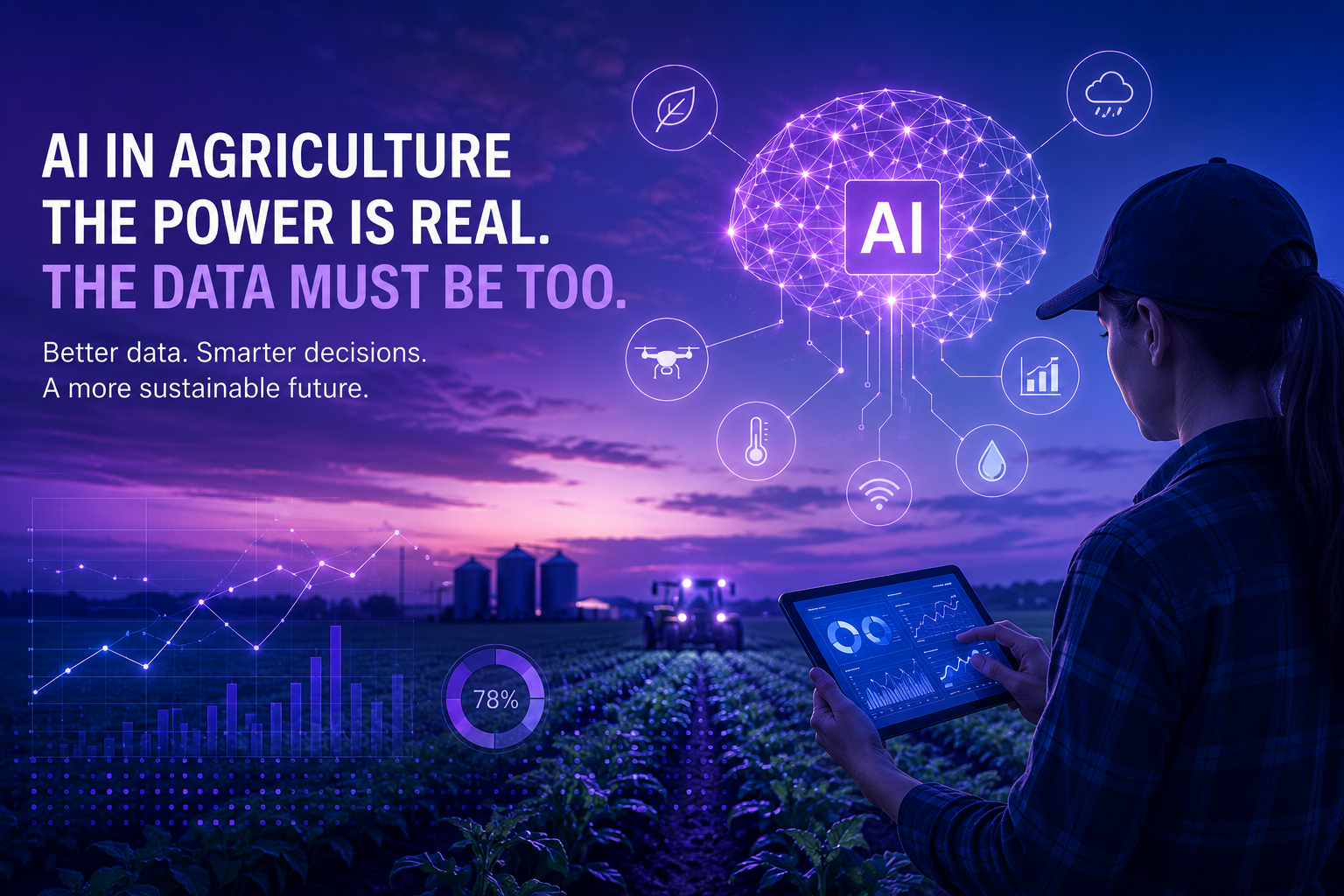
Modern farms generate enormous volumes of data through sensors, satellites, drones, weather stations, machinery, and farm management software.
However, these datasets often exist in isolated systems, follow different standards, and are difficult to integrate. As a result, AI models may struggle to produce reliable recommendations because they lack consistent, high-quality inputs.
This challenge extends across the entire agrifood value chain. Crop data, soil measurements, machinery records, weather observations, and supply chain information are frequently stored by different platforms that cannot easily communicate with one another. Without interoperability and standardized data structures, even the most advanced AI systems cannot deliver their full potential.
The issue is particularly important as agriculture faces increasing pressure to improve productivity while reducing environmental impact. Farmers are expected to optimize water use, reduce fertilizer application, lower greenhouse gas emissions, and adapt to increasingly unpredictable weather conditions. AI can support these objectives—but only if it is trained on accurate, representative, and continuously updated data.
Rather than rushing to implement the latest AI solutions, agricultural businesses should first invest in building robust digital foundations. This includes improving data collection practices, adopting common standards, ensuring data interoperability, and establishing governance frameworks that allow information to be securely shared across the ecosystem.
For startups and AgTech innovators, this represents both a challenge and a significant business opportunity. Companies developing data platforms, farm management systems, IoT infrastructure, remote sensing technologies, and data integration solutions may become just as important as those building AI models themselves. In many cases, creating "AI-ready" datasets will generate greater long-term value than deploying another machine learning application.
Europe has already begun moving in this direction through investments in digital agriculture, precision farming, and collaborative innovation programmes that encourage data sharing between farmers, researchers, technology providers, and industry partners. As AI adoption accelerates, success will increasingly depend on the strength of the underlying digital ecosystem rather than the sophistication of the algorithms alone.
The future of AI in agriculture is undoubtedly promising.

However, before artificial intelligence can transform farming at scale, the sector must first solve a more fundamental problem: building trustworthy, connected, and high-quality data infrastructure. In agriculture, better decisions begin with better data.
These challenges are already at the heart of several initiatives led by Agriventures. Through the SAFE-AGRI Initiative, the organisation is bringing together researchers, innovators, farmers, policymakers, and industry experts to explore how artificial intelligence, digital technologies, and emerging innovations can be implemented responsibly across the agrifood sector.
As highlighted during the recent SAFE-AGRI Workshop, building trustworthy AI requires more than advanced algorithms—it depends on robust data governance, stakeholder collaboration, and responsible innovation frameworks that ensure technologies deliver real value for both farmers and society.
Learn more about these initiatives:
SAFE-AGRI Workshop: Bringing Together Stakeholders to Shape Responsible Innovation in the Agri-Food Sector – https://agriventures.co/updates/safe-agri-workshop-brings-together-stakeholders-to-shape-responsible-innovation-in-the-agri-food-sec
SAFE-AGRI Initiative Officially Kicks Off – https://agriventures.co/updates/safe-agri-initiative-officially-kicks-off

The role of Agriventures in supporting agrifood innovation
As the agritech startup ecosystem grows across Europe, initiatives such as Agriventures are helping connect entrepreneurs, researchers, investors, and policymakers working in agriculture and food innovation.
Agriventures focuses on supporting agrifood startups, biotechnology innovation, and access to European funding for agriculture, while also helping entrepreneurs navigate the complex landscape of startup financing, venture capital, and research commercialization.
By strengthening connections between startups, research institutions, investors, and farmers, Agriventures contributes to building a stronger agricultural innovation ecosystem that can accelerate the transition toward sustainable agriculture and resilient food systems.
Through knowledge sharing, events, and ecosystem building, Agriventures helps ensure that promising agritech innovations can scale and reach farmers, food producers, and global markets.
Source: https://www.technologyreview.com/2026/06/30/1139513/agriculture-is-ready-for-ai-but-its-data-isnt/
Tags
Related Articles
Continue reading our latest insights and updates from the AgriVentures ecosystem.

Biotechnology, Agri-Inputs and Biosecurity: Why the Future of Farming Needs a Wider Conversation in Sofia
Agriculture is undergoing a quiet transformation. Genomic tools, precision biological solutions, and new generations of crop protection and plant nutrition products are changing what is possible in the field and along the whole food chain. At the same time, the same advances raise questions that the sector is only beginning to ask. Who controls the genetic resources and seeds we depend on? How do we manage biosecurity when biological agents and genomic technologies can be used for more than...

Where Agrifood Biotech and Research Funding Is Actually Going in 2026
Basic research doesn't fund itself, and in agrifood, the gap between a promising lab result and a fundable project often comes down to knowing which of a dozen overlapping EU programmes to approach first. Food safety science, biotech platforms, and multi-country research consortia each follow their own funding logic, and 2026 has brought fresh calls across all three. Two Live Examples Worth Studying Safe-Agri, one of AgriVentures' active projects, is reinforcing the security assessment...

VerAgro launches a free self-assessment to help farms measure - and improve - their sustainability
"How sustainable is your farm?" It's a question most producers can answer instinctively, but rarely with hard numbers. A new Bulgarian startup wants to change that. VerAgro, a Bulgaria-based agtech startup, has launched a free online self-assessment that gives farms and processors a clear, structured picture of where they stand on sustainability — and what to do next. A 20-minute check-up for your farm The tool works like a health check-up for your operation. Farmers and processors answer 57...

A New Door Is Opening for Bulgarian Farmers and Agri-Innovators - And It's Fully Funded
For years, the biggest barrier between Bulgarian agriculture and Europe's most advanced farms hasn't been ambition. It's been access — to the right rooms, the right people, and the budget to get there. AgriVentures' new Missions program was built to remove exactly that barrier, and it does it in a way few programs in the region ever have: by covering the full cost of getting Bulgarian farmers, entrepreneurs, scientists, and companies in front of Europe's leading agri-food innovators. If you...

Inside projects.agriventures.co: Your Gateway to EU AgriFood Innovation
AgriVentures has launched projects.agriventures.co, a dedicated portal that brings the full portfolio of our EU-funded initiatives into one place. Where agriventures.co connects agrifood innovators with funding, the Projects site shows what happens next: the live programmes, Living Lab pilots, and network activity that funding makes possible. Here's what you'll find on the site — and how each part of our community can put it to work. A Live Portfolio of EU Projects The homepage opens with our...

Understanding Biomass Flows in Europe: A €6M Horizon Europe Call Agrifood Founders Shouldn't Miss
A question we've been getting a lot lately, including from our own LinkedIn community, is some version of: "Can my startup actually apply for this, and how?" This time it's about Understanding biomass flows in Europe (HORIZON-CL6-2026-01-CIRCBIO-05), a Horizon Europe call with a total budget of €6,000,000 that opened on 17 April 2026 and closes on 17 September 2026. It's exactly the kind of opportunity worth breaking down properly, because the honest answer is "yes, but not the way most...
Never Miss an Update
Join our community to receive the latest insights, funding opportunities, and industry news from AgriVentures.