Generational Renewal in Agriculture: Securing the Future of European Farming

Across Europe, farming is facing a profound transition. The average farmer today is 57 years old, and only twelve percent are under the age of forty. Among this younger group, fewer than three percent are women. These figures reveal an urgent truth — if we do not act now to bring new generations into agriculture, the foundations of
Europe’s food security and rural life could weaken beyond repair.
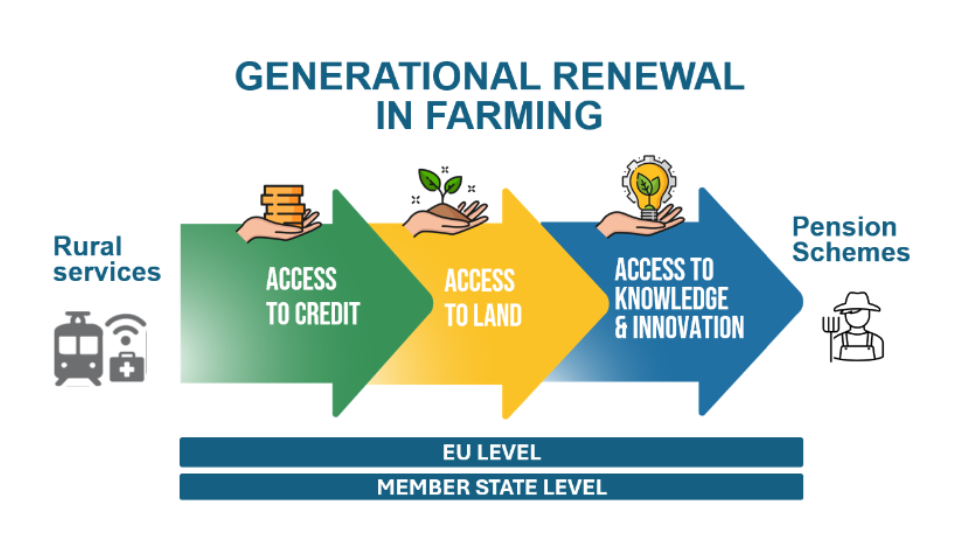
To respond to this challenge, the European Commission has launched a new Strategy for Generational Renewal in Agriculture. This plan is more than a policy document — it is a call to action to make farming once again a viable, fulfilling, and forward-looking career for young people across the continent.
The goal is ambitious yet achievable: by 2040, the share of young farmers in the European Union should double, rising from twelve to twenty-four percent.
This transformation cannot happen without targeted support. That is why the Commission recommends that every Member State dedicate at least six percent of its agricultural spending to generational renewal. These funds will back a “starter pack” for young farmers — a mix of financial aid, access to credit, training, land, and mentorship — designed to help new entrants establish themselves, innovate, and grow.
At the heart of this strategy lies the recognition that farming is about people. Young farmers today face a web of barriers: limited access to land, credit and capital, complex bureaucracy, and the social perception that life in rural areas offers fewer opportunities. Overcoming these obstacles requires coordinated action that goes beyond agriculture alone. The strategy envisions stronger rural infrastructure, better education and healthcare services, more inclusive communities, and fairer pension systems that allow older farmers to retire with dignity and confidence, passing their farms to the next generation.
But generational renewal is not only about preserving tradition — it is about driving innovation. Young farmers are at the forefront of change. They are building businesses that merge sustainability with technology, integrating renewable energy, bioeconomy solutions, and digital tools into everyday farming. They bring fresh perspectives to how we produce food, care for our land, and connect with consumers.
The new framework under the Common Agricultural Policy (CAP) after 2027 places generational renewal at its core. It calls for reforms that make access to land and finance fairer, ensure predictable long-term investment conditions, and strengthen networks for knowledge exchange.
Each Member State will be expected to prepare a national strategy on generational renewal — identifying demographic trends, barriers to entry, and measurable targets to attract and retain young people in farming.
Beyond economic measures, the European Commission is also investing in inspiration. Initiatives such as the Rural Youth Ambassadors programme will highlight the voices of young farmers who are shaping the future of agriculture and rural life. A new Women in Farming Platform will promote equal opportunities, mentoring, and visibility for women who want to take leadership roles in the sector.
For Agriventures, this strategy resonates deeply. It reflects our mission to empower young entrepreneurs, innovators, and farmers in Bulgaria and beyond.
Generational renewal is not just an EU objective — it is a shared commitment to keep our rural communities alive, our food systems resilient, and our connection to the land intact.
Europe’s agricultural renewal will depend on courage, collaboration, and creativity. By supporting the next generation of farmers, we are not only protecting our food future — we are investing in a fairer, greener, and more connected Europe.
1. Access to Finance
Young farmers face the steepest entry barriers when starting a farm. Access to affordable credit, long-term loans, and investment capital remains limited, especially for those without collateral or family land. To change this, the new CAP proposes a significant increase in financial support.
The EU will triple the maximum start-up aid for young farmers, raising it to €300,000 when provided through financial instruments. Member States will also be encouraged to design Loan and Guarantee Funds tailored to young farmers — with lower interest rates, longer repayment periods, and grace periods that ease financial pressure during the first years of business.
Investment aid could reach up to 85% of project costs, and Member States will be urged to give higher grant rates or bonus points to underrepresented groups, including young female farmers.
The strategy also strengthens collaboration with the European Investment Bank Group (EIBG) to create guarantee schemes and interest rate subsidies. Access to finance will be expanded for sustainable technologies, digitalization, organic farming, and renewable energy.
All these measures come together under the proposed “Starter Pack for Young Farmers” — a one-stop entry point offering installation aid, financial instruments, investment support, and training.
2. Access to Knowledge and Skills
Generational renewal cannot succeed without the right education and training. Young farmers need both traditional agricultural know-how and modern business, digital, and sustainability skills.
Under the Agricultural Knowledge and Innovation System (AKIS), mentoring and advisory services will guide young farmers before and after they set up their farms — from land access and business planning to digital tools and sustainability.
The EU will boost the Erasmus for Young Entrepreneurs programme to help aspiring farmers learn from experienced ones across Europe. It will also launch a “Farmers of the Future” educational pack for agricultural schools, showcasing innovation, diversification, and digital tools.
A new Women in Farming Platform will promote equal opportunities, mentoring, and visibility for women in agriculture.
The Pact for Skills and the Talent Platform for Agriculture will provide lifelong learning and reskilling opportunities, while the ALMA programme will support NEETs (young people not in education or employment) in discovering careers in farming.
3. Access to Land
Land is the foundation of farming — but it is increasingly difficult for young people to access. Prices remain high, ownership is concentrated, and succession is slow.
To increase transparency and fairness, the EU will create a European Land Observatory, gathering data on land transactions, prices, and ownership to inform national policies and prevent speculation.
Member States are encouraged to develop national land mobility schemes that connect retiring farmers with new entrants, promote long-term leasing instead of short-term tenancies, and prioritise young farmers in the allocation of public land.
Alternative models such as land banks, community land trusts, and farm incubators will receive support to help newcomers start farming without heavy upfront costs.
Each country is expected to align with the EU’s “no net land take by 2050” objective, ensuring farmland remains available for agriculture and not lost to urbanisation or speculation.
4. Fair Living Conditions and Rural Resilience
Renewing generations in farming is impossible without vibrant rural communities. Many young people leave rural areas not because they don’t love the land, but because life there often lacks opportunities, services, and social infrastructure.
The strategy calls for improving healthcare, childcare, housing, transport, education, and digital connectivity in rural regions. Stronger social protection and pension systems will help make farming a secure career choice, especially for women and part-time farmers.
Economic diversification is central to resilience. Young farmers will be encouraged to combine traditional production with bioeconomy, renewable energy, agritourism, and short supply chains.
The EU’s Carbon Farming Certification Framework will provide opportunities for farmers to generate additional income through carbon credits.
New initiatives like Farm Relief Services will allow farmers to take time off for illness, family care, or training. The Rural Youth Ambassadors Programme will promote positive rural stories and show that farming can offer purpose, innovation, and quality of life.
5. Succession and Retirement
Renewal requires space for the next generation to step in — and that means supporting older farmers to retire with dignity. Across Europe, many older farmers continue working well past retirement because their pensions are too small or succession is too complex.
The strategy links direct payments to pension age by 2032, ensuring that farmers who retire and receive a pension pass their farms on to younger generations.
Through the CAP’s advisory services, older farmers will receive guidance on legal, financial, and inheritance planning, while young farmers will learn how to manage smooth takeovers.
Member States are encouraged to reform inheritance and taxation laws to make farm transfers easier and fairer. The Commission will also study how different fiscal systems affect succession and retirement to promote effective reforms.
Adequate pension schemes, inclusive social protection, and targeted training in succession planning are key to unlocking one of the most sensitive but crucial transitions in agriculture.
The Road Ahead
By 2028, every EU Member State must have its own national strategy for generational renewal, combining agricultural, fiscal, and social measures. The European Commission will monitor progress, ensuring that at least six percent of agricultural funds are invested in young farmers and that results are transparent and measurable.
The strategy’s long-term vision is clear: by 2040, Europe’s agriculture should be younger, more inclusive, innovative, and resilient.
For Agriventures, this is more than a European policy — it is a shared mission. Empowering young farmers, innovators, and researchers to take part in the transformation of food and agriculture is how we ensure that Europe’s fields continue to grow not only crops but also opportunity, hope, and renewal.
Tags
Related Articles
Continue reading our latest insights and updates from the AgriVentures ecosystem.

Biotechnology, Agri-Inputs and Biosecurity: Why the Future of Farming Needs a Wider Conversation in Sofia
Agriculture is undergoing a quiet transformation. Genomic tools, precision biological solutions, and new generations of crop protection and plant nutrition products are changing what is possible in the field and along the whole food chain. At the same time, the same advances raise questions that the sector is only beginning to ask. Who controls the genetic resources and seeds we depend on? How do we manage biosecurity when biological agents and genomic technologies can be used for more than...

Where Agrifood Biotech and Research Funding Is Actually Going in 2026
Basic research doesn't fund itself, and in agrifood, the gap between a promising lab result and a fundable project often comes down to knowing which of a dozen overlapping EU programmes to approach first. Food safety science, biotech platforms, and multi-country research consortia each follow their own funding logic, and 2026 has brought fresh calls across all three. Two Live Examples Worth Studying Safe-Agri, one of AgriVentures' active projects, is reinforcing the security assessment...

VerAgro launches a free self-assessment to help farms measure - and improve - their sustainability
"How sustainable is your farm?" It's a question most producers can answer instinctively, but rarely with hard numbers. A new Bulgarian startup wants to change that. VerAgro, a Bulgaria-based agtech startup, has launched a free online self-assessment that gives farms and processors a clear, structured picture of where they stand on sustainability — and what to do next. A 20-minute check-up for your farm The tool works like a health check-up for your operation. Farmers and processors answer 57...

A New Door Is Opening for Bulgarian Farmers and Agri-Innovators - And It's Fully Funded
For years, the biggest barrier between Bulgarian agriculture and Europe's most advanced farms hasn't been ambition. It's been access — to the right rooms, the right people, and the budget to get there. AgriVentures' new Missions program was built to remove exactly that barrier, and it does it in a way few programs in the region ever have: by covering the full cost of getting Bulgarian farmers, entrepreneurs, scientists, and companies in front of Europe's leading agri-food innovators. If you...

Inside projects.agriventures.co: Your Gateway to EU AgriFood Innovation
AgriVentures has launched projects.agriventures.co, a dedicated portal that brings the full portfolio of our EU-funded initiatives into one place. Where agriventures.co connects agrifood innovators with funding, the Projects site shows what happens next: the live programmes, Living Lab pilots, and network activity that funding makes possible. Here's what you'll find on the site — and how each part of our community can put it to work. A Live Portfolio of EU Projects The homepage opens with our...

Understanding Biomass Flows in Europe: A €6M Horizon Europe Call Agrifood Founders Shouldn't Miss
A question we've been getting a lot lately, including from our own LinkedIn community, is some version of: "Can my startup actually apply for this, and how?" This time it's about Understanding biomass flows in Europe (HORIZON-CL6-2026-01-CIRCBIO-05), a Horizon Europe call with a total budget of €6,000,000 that opened on 17 April 2026 and closes on 17 September 2026. It's exactly the kind of opportunity worth breaking down properly, because the honest answer is "yes, but not the way most...
Never Miss an Update
Join our community to receive the latest insights, funding opportunities, and industry news from AgriVentures.