Is Agrifood Ready for a Cyberattack? Why Security Must Become Part of How We Farm

As food systems digitalise, cyberattacks increasingly cause spoilage, empty shelves and even livestock deaths. Here is why cybersecurity must become core to agrifood, and how Agriventures is driving the conversation.
At a glance: Cyberattacks on food systems are rising fast, and because food is physical they can spoil product, empty shelves and even harm animals | This is exactly the conversation Agriventures has been driving | Our next Safe-Agri workshop takes place on 27 October in Sofia
Digitalisation is transforming how food is grown, processed, moved and sold. It is also quietly expanding the attack surface of the entire food system. A recent opinion piece in AgFunderNews put it plainly: it is time to take action on cybersecurity in agrifood. We agree, and at Agriventures we have been building exactly this conversation for months.
The core point is simple but serious. Because food systems are physical, a successful cyberattack does not just leak data. It can spoil product, empty shelves, start fires and harm animals. In other words, a cyber incident in agrifood can quickly become a food security problem.
The risk is already real
The examples are no longer hypothetical. Recent attacks have pushed supermarket freezers to dangerous temperatures and caused spoilage and fires, disabled the ordering systems of major food distributors, and even taken herd-monitoring offline on farms, leading to the first confirmed livestock death from a cyberattack. Ransomware across the sector roughly doubled in 2025, and the true figure is almost certainly higher, because disclosure requirements remain weak and many attacks never become public.
The vulnerabilities are structural: internet-connected freezers and controls running outdated firmware, building and herd-monitoring systems that can be switched off remotely, and precision-agriculture tools that security agencies have flagged but barely updated guidance on. As researchers now describe it, agriculture is shifting from "farm-to-fork" to "farm-to-fiber," a digitally interconnected ecosystem where a single weak link can cascade. The consensus emerging from the sector is clear: move from reactive crisis management toward anticipatory resilience, and treat cyberhealth as core to operations, alongside crop health, animal health and food safety.
Why this matters to us, and what Agriventures is already doing
This is precisely the agenda Agriventures has been advancing in Bulgaria and across the European agri-food sector. We have written about biotechnology, traceability and biosecurity in agriculture, explored the country's digital readiness in an interview with our Executive Director, Mariya Hristova, and argued that the future of farming needs a wider conversation on agri-inputs, biosecurity and responsible innovation.
This is not new ground for us. Back on 6 July, under our SAFE-AGRI initiative, we ran our first stakeholder co-creation workshop, bringing together more than 15 participants from academia, research organisations, technology providers, agricultural businesses and industry associations. Working in multidisciplinary groups and guided by the Responsible Research and Innovation (ORRI) framework, participants worked through foresight scenarios on exactly the risks now making headlines: artificial intelligence, autonomous agricultural systems, smart sensors, cloud infrastructures, data governance, cybersecurity and technologies with dual-use potential.
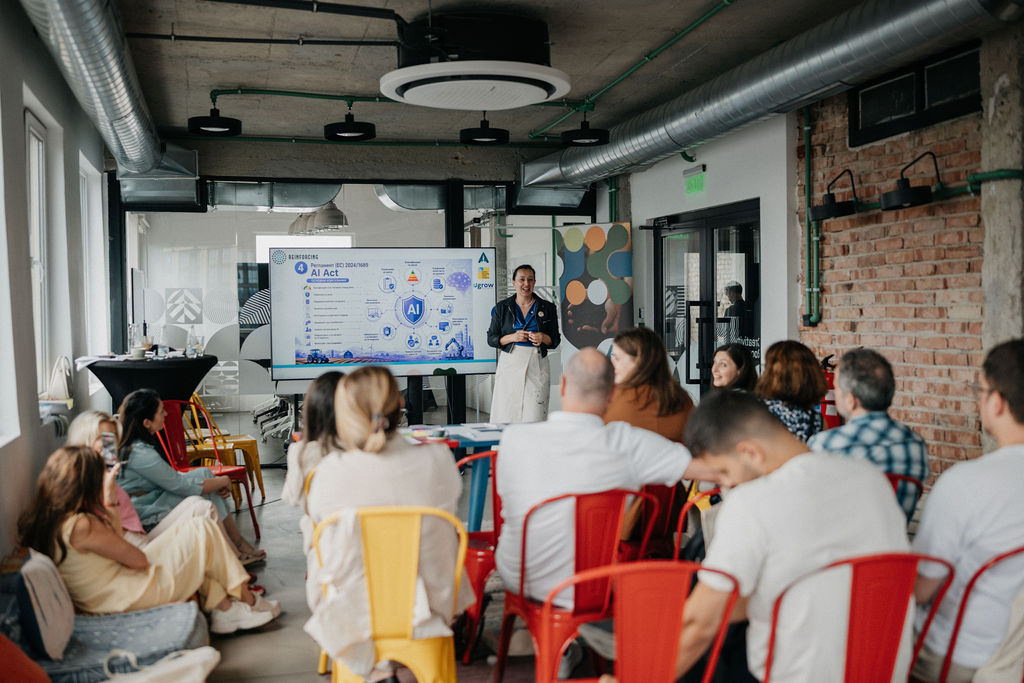
They mapped vulnerabilities, weighed ethical and societal implications, and proposed practical mitigation measures across operational resilience, food security, critical digital infrastructures and data sovereignty.
The methodology mattered as much as the topics. By bringing different sectors into the same room and applying the ORRI principles of anticipation, inclusion, reflexivity and responsiveness, the workshop turned a broad, intimidating challenge into concrete, prioritised measures, and into new connections across the innovation ecosystem.
In short, we were already doing in July what the sector is now being urged to scale: participatory, cross-sector, anticipatory work on secure and responsible technology in agriculture.
Join the next conversation: 27 October, Sofia
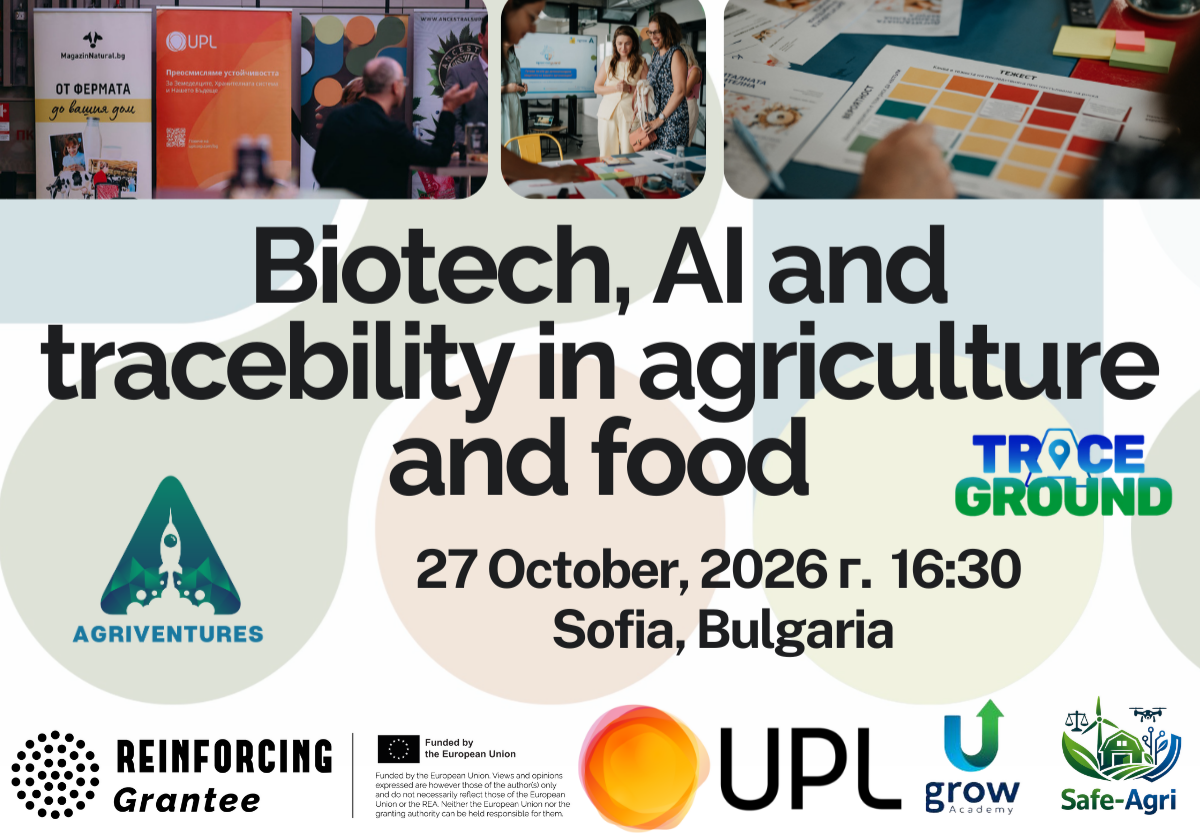
The work continues. Our next Safe-Agri workshop takes place on 27 October 2026 in Sofia, organised together with UPL Bulgaria and TraceGround. It is a boutique, invite-style gathering that brings researchers, entrepreneurs, public-sector representatives and industry around the same table to work through near-future cases on biotechnology, agri-inputs, traceability, biosecurity and dual-use technologies. If cybersecurity, resilience and responsible innovation in agrifood are on your agenda, this is the room to be in.
Through SAFE-AGRI and our wider community, Agriventures is helping turn a pressing warning into practical, collaborative action for a more secure and trustworthy food system. The defenders need to be prepared, and we are building that readiness in Bulgaria and across Europe.
Register for the 27 October workshop here: https://luma.com/d02un2oa?tk=AV5eox
You can also read how it all began in our article on the official launch of the SAFE-AGRI initiative.
SAFE-AGRI is supported through the REINFORCING project, funded by the European Union. Views and opinions expressed are those of the author(s) only and do not necessarily reflect those of the European Union or the European Research Executive Agency (REA). Neither the European Union nor the granting authority can be held responsible for them.
Source: "It's time to take action on cybersecurity in agrifood", AgFunderNews, 12 October 2026.
Check out our guides for funding opportunities
https://projects.agriventures.co/resources
Agriventures Connect 3.0 is coming on 20th of April 2027 in Sofia, Bulgaria
https://connect.agriventures.co/
The role of Agriventures in supporting agrifood innovation
As the agritech startup ecosystem grows across Europe, initiatives such as Agriventures are helping connect entrepreneurs, researchers, investors, and policymakers working in agriculture and food innovation.
Agriventures focuses on supporting agrifood startups, biotechnology innovation, and access to European funding for agriculture, while also helping entrepreneurs navigate the complex landscape of startup financing, venture capital, and research commercialization.
By strengthening connections between startups, research institutions, investors, and farmers, Agriventures contributes to building a stronger agricultural innovation ecosystem that can accelerate the transition toward sustainable agriculture and resilient food systems.
Through knowledge sharing, events, and ecosystem building, Agriventures helps ensure that promising agritech innovations can scale and reach farmers, food producers, and global markets.
Tags
Related Articles
Continue reading our latest insights and updates from the AgriVentures ecosystem.

🌱 SYSARM Project: Join Our Regional Learning Alliances!
The SYSARM (Systems Thinking for Agricultural Risk Management) project is entering an important phase: the development of Regional Learning Alliances (RLAs) that bring together key stakeholders to improve agricultural risk management through systems thinking, collaboration, and knowledge exchange. 🤝 Why join a SYSARM Regional Learning Alliance? By participating, your organisation can: ✅ Share your expertise and needs — contribute your practical experience and help identify the key...

World Food Day 2026: 50 Funding Opportunities for Food Security and Sustainable Food Systems
To mark World Food Day, Agriventures has published a free guide to 50 funding calls, prizes and programmes for food security and sustainable food systems, each with a direct link to the official call page. World Food Day falls on 16 October, the date FAO was founded in 1945. This year's message, “Innovate today. Nourish tomorrow.”, puts innovation at the centre: not only data, AI and robots, but also traditional knowledge, existing solutions used in new ways, and better methods to produce...

Biotechnology, Agri-Inputs and Biosecurity: Why the Future of Farming Needs a Wider Conversation in Sofia
Agriculture is undergoing a quiet transformation. Genomic tools, precision biological solutions, and new generations of crop protection and plant nutrition products are changing what is possible in the field and along the whole food chain. At the same time, the same advances raise questions that the sector is only beginning to ask. Who controls the genetic resources and seeds we depend on? How do we manage biosecurity when biological agents and genomic technologies can be used for more than...

Where Agrifood Biotech and Research Funding Is Actually Going in 2026
Basic research doesn't fund itself, and in agrifood, the gap between a promising lab result and a fundable project often comes down to knowing which of a dozen overlapping EU programmes to approach first. Food safety science, biotech platforms, and multi-country research consortia each follow their own funding logic, and 2026 has brought fresh calls across all three. Two Live Examples Worth Studying Safe-Agri, one of AgriVentures' active projects, is reinforcing the security assessment...

VerAgro launches a free self-assessment to help farms measure - and improve - their sustainability
"How sustainable is your farm?" It's a question most producers can answer instinctively, but rarely with hard numbers. A new Bulgarian startup wants to change that. VerAgro, a Bulgaria-based agtech startup, has launched a free online self-assessment that gives farms and processors a clear, structured picture of where they stand on sustainability — and what to do next. A 20-minute check-up for your farm The tool works like a health check-up for your operation. Farmers and processors answer 57...

A New Door Is Opening for Bulgarian Farmers and Agri-Innovators - And It's Fully Funded
For years, the biggest barrier between Bulgarian agriculture and Europe's most advanced farms hasn't been ambition. It's been access — to the right rooms, the right people, and the budget to get there. AgriVentures' new Missions program was built to remove exactly that barrier, and it does it in a way few programs in the region ever have: by covering the full cost of getting Bulgarian farmers, entrepreneurs, scientists, and companies in front of Europe's leading agri-food innovators. If you...
Never Miss an Update
Join our community to receive the latest insights, funding opportunities, and industry news from AgriVentures.