What the New EU–Mexico Agreement Means for European Farmers in Practice

The newly modernised EU-Mexico Agreement is more than just another trade deal. For European farmers, food processors and agricultural cooperatives, it opens a large and growing market of over 130 million consumers while reducing export barriers that have limited competitiveness for years.
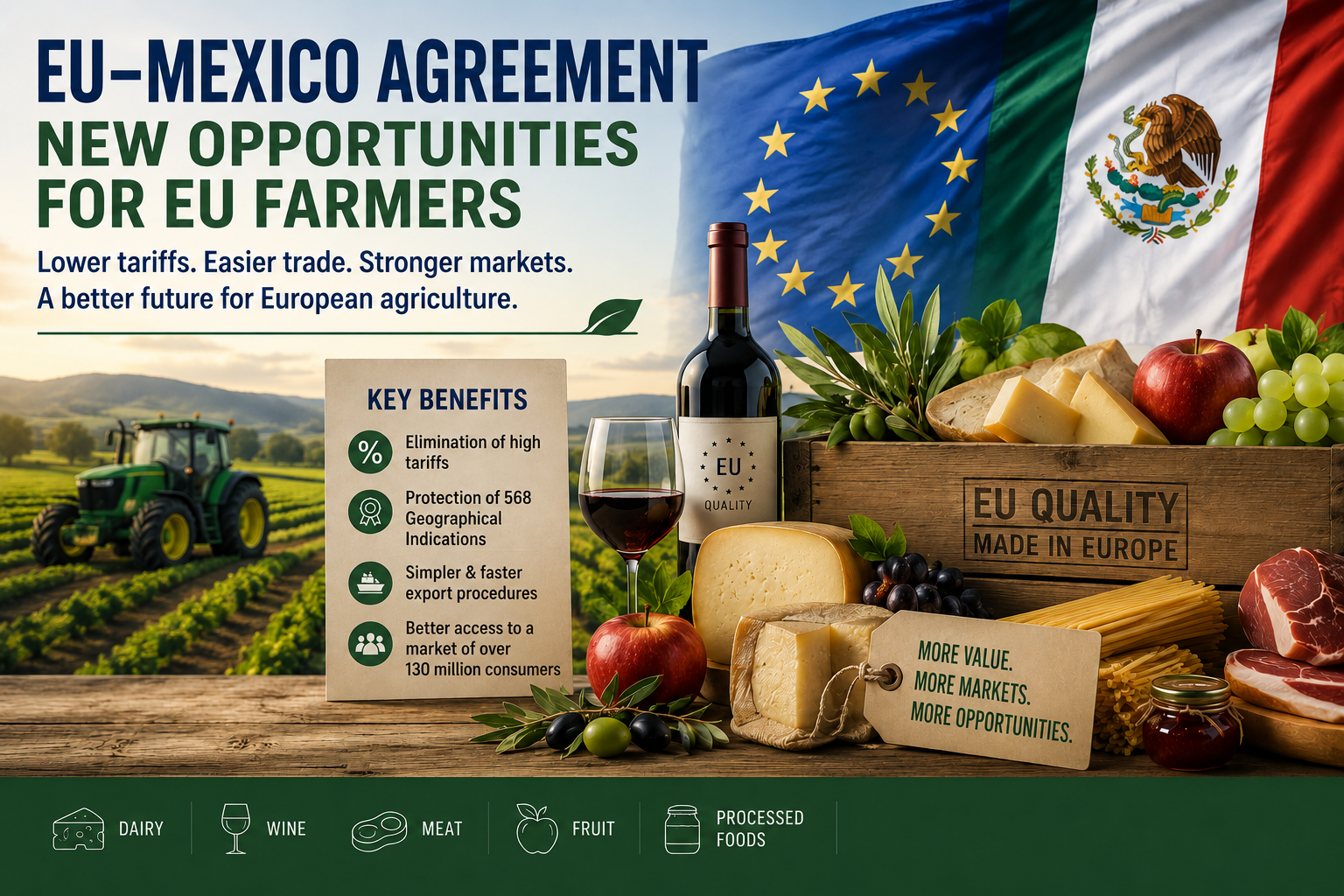
The agreement was officially signed in May 2026 after long negotiations between the European Union and Mexico.
But what does this actually mean on the farm level?
Lower Tariffs = Better Export Opportunities
One of the biggest practical benefits is the removal of high Mexican import tariffs on European agri-food products. According to the European Commission, tariffs as high as 100% will disappear for important EU products such as cheese, pork, poultry, pasta, chocolate, apples, jams, wine and dairy products.
For farmers, this means European products can become significantly more competitive in Mexico compared to products from countries without similar trade advantages.
Practical example:
A dairy cooperative in France, the Netherlands or Bulgaria exporting specialty cheese can now access the Mexican market with fewer cost disadvantages.
Wine producers from Italy, Spain or Portugal may increase exports because Mexican distributors will pay lower import duties.
Fruit and vegetable growers may benefit from easier access for processed and premium products.
This is especially important because Mexico is already the EU’s second-largest importer of agri-food products in Latin America.
EU food and drink exports to Mexico are currently worth around €2.7 billion annually.
Protection of European Quality Products
The agreement protects 568 European geographical indications (GIs).
This means products with regional identity and strong branding receive legal protection against imitation in Mexico.
If a producer sells products such as Parmigiano Reggiano, Rioja wine, Feta, Prosciutto di Parma or other protected regional foods, Mexican companies will not be allowed to market imitations under those names.
For farmers and processors focused on premium products, this creates stronger long-term brand value and pricing power.
Faster and Simpler Export Procedures
The agreement also aims to simplify customs and administrative procedures.
This may sound technical, but it matters in daily operations: Faster border checks, Less paperwork, More predictable export procedures, Lower logistics costs
For small and medium-sized agricultural businesses, reducing bureaucracy can be just as important as lowering tariffs.
Opportunities Beyond Large Agribusiness
Although large exporters will likely benefit first, the agreement can also help smaller farmers indirectly. Many SMEs already export through: cooperatives, food processors, traders, wine associations, dairy unions, regional producer organisations. As Mexican demand for European products grows, local supply chains inside Europe may also expand.
For example:
Grain farmers may benefit indirectly through higher demand from pasta or food manufacturers.
Livestock farms may gain from stronger meat-processing exports.
Fruit growers could find new opportunities in processed foods and premium packaged products.
What Farmers Should Do Now
Practical steps:
Focus on quality and traceability
Mexican consumers increasingly value premium European food products.
Invest in branding
Regional identity and product storytelling will become more important.
Explore cooperatives and export partnerships
Smaller farms rarely export alone successfully.
Follow certification requirements carefully
Export markets demand strict standards on food safety and quality.
Watch market trends
Products with added value usually benefit more than raw commodities.
The agreement is not a guaranteed win for every farmer.
Some sectors may face stronger competition globally, and export success still depends on logistics, exchange rates, production costs and market organisation.
In addition, the agreement still needs full ratification procedures before complete implementation across all areas. However, the direction is clear: the EU is trying to diversify agricultural trade partnerships and reduce dependence on unstable global markets.
Farmers who focus on quality, cooperation, branding and export readiness are likely to benefit the most over the next decade.
The agreement creates opportunities — but the farms that prepare early will be the ones best positioned to capture them.
The role of Agriventures in supporting agrifood innovation
As the agritech startup ecosystem grows across Europe, initiatives such as Agriventures are helping connect entrepreneurs, researchers, investors, and policymakers working in agriculture and food innovation.
Agriventures focuses on supporting agrifood startups, biotechnology innovation, and access to European funding for agriculture, while also helping entrepreneurs navigate the complex landscape of startup financing, venture capital, and research commercialization.
By strengthening connections between startups, research institutions, investors, and farmers, Agriventures contributes to building a stronger agricultural innovation ecosystem that can accelerate the transition toward sustainable agriculture and resilient food systems.
Through knowledge sharing, events, and ecosystem building, Agriventures helps ensure that promising agritech innovations can scale and reach farmers, food producers, and global markets.
Tags
Related Articles
Continue reading our latest insights and updates from the AgriVentures ecosystem.

Biotechnology, Agri-Inputs and Biosecurity: Why the Future of Farming Needs a Wider Conversation in Sofia
Agriculture is undergoing a quiet transformation. Genomic tools, precision biological solutions, and new generations of crop protection and plant nutrition products are changing what is possible in the field and along the whole food chain. At the same time, the same advances raise questions that the sector is only beginning to ask. Who controls the genetic resources and seeds we depend on? How do we manage biosecurity when biological agents and genomic technologies can be used for more than...

Where Agrifood Biotech and Research Funding Is Actually Going in 2026
Basic research doesn't fund itself, and in agrifood, the gap between a promising lab result and a fundable project often comes down to knowing which of a dozen overlapping EU programmes to approach first. Food safety science, biotech platforms, and multi-country research consortia each follow their own funding logic, and 2026 has brought fresh calls across all three. Two Live Examples Worth Studying Safe-Agri, one of AgriVentures' active projects, is reinforcing the security assessment...

VerAgro launches a free self-assessment to help farms measure - and improve - their sustainability
"How sustainable is your farm?" It's a question most producers can answer instinctively, but rarely with hard numbers. A new Bulgarian startup wants to change that. VerAgro, a Bulgaria-based agtech startup, has launched a free online self-assessment that gives farms and processors a clear, structured picture of where they stand on sustainability — and what to do next. A 20-minute check-up for your farm The tool works like a health check-up for your operation. Farmers and processors answer 57...

A New Door Is Opening for Bulgarian Farmers and Agri-Innovators - And It's Fully Funded
For years, the biggest barrier between Bulgarian agriculture and Europe's most advanced farms hasn't been ambition. It's been access — to the right rooms, the right people, and the budget to get there. AgriVentures' new Missions program was built to remove exactly that barrier, and it does it in a way few programs in the region ever have: by covering the full cost of getting Bulgarian farmers, entrepreneurs, scientists, and companies in front of Europe's leading agri-food innovators. If you...

Inside projects.agriventures.co: Your Gateway to EU AgriFood Innovation
AgriVentures has launched projects.agriventures.co, a dedicated portal that brings the full portfolio of our EU-funded initiatives into one place. Where agriventures.co connects agrifood innovators with funding, the Projects site shows what happens next: the live programmes, Living Lab pilots, and network activity that funding makes possible. Here's what you'll find on the site — and how each part of our community can put it to work. A Live Portfolio of EU Projects The homepage opens with our...

Understanding Biomass Flows in Europe: A €6M Horizon Europe Call Agrifood Founders Shouldn't Miss
A question we've been getting a lot lately, including from our own LinkedIn community, is some version of: "Can my startup actually apply for this, and how?" This time it's about Understanding biomass flows in Europe (HORIZON-CL6-2026-01-CIRCBIO-05), a Horizon Europe call with a total budget of €6,000,000 that opened on 17 April 2026 and closes on 17 September 2026. It's exactly the kind of opportunity worth breaking down properly, because the honest answer is "yes, but not the way most...
Never Miss an Update
Join our community to receive the latest insights, funding opportunities, and industry news from AgriVentures.