Adapting Manufacturing Demonstration Facilities for Local Biofertilizer Production: Enthela’s NEB-Aligned Innovation

The STARHAUS Open Call #OIC2 brought together creative and technological innovators under the principles of the New European Bauhaus, promoting sustainability, accessibility, resilience, and human-centric design. Within this collaborative framework, Enthela’s project—Adapting Manufacturing Demonstration Facilities (MDFs) for Biofertilizer Production: Sustainable & Scalable Solutions—was selected under the Fertilizer use-case for its potential to transform plant nutrition and reduce reliance on synthetic inputs.
The project responds to a clear and urgent challenge: the need for sustainable fertilization practices that are accessible to everyday growers.
By reimagining Manufacturing Demonstration Facilities, originally built for digitalized and automated production, Enthela is creating a localized system capable of producing tailored microbial fertilizers.
This approach combines real-time soil diagnostics with automated formulation, making advanced agronomic insight available at neighborhood scale.
At the center of the system is a Soil Sensor Module equipped with ion-selective electrodes (ISEs). These sensors measure key nutrients—nitrogen, phosphorus, potassium—as well as salinity and environmental conditions.
The measurements enable precise, site-specific analysis of soil needs. Based on these readings, the MDF machine automatically prepares a custom microbial formulation, creating a biofertilizer tailored to the soil’s current condition. This adaptive dosing approach supports hobby gardeners—the target “prosumer” segment—who are increasingly interested in low-toxicity, sustainable practices. Both market and cultural signals reinforce this trend: the organic fertilizer market in Europe is projected to grow significantly, the EU is promoting urban and peri-urban gardening, and consumers are actively seeking environmentally responsible growing solutions.
Enthela’s team validated these wider signals with direct interviews in Bulgaria and Germany. Gardeners consistently expressed interest in biological solutions that improve yields while remaining pollinator-safe and low-residue, confirming strong product-market fit.
The project highlights the rising importance of microbial fertilizers. These living formulations enhance nutrient availability, improve soil biodiversity, support plant stress tolerance, and reduce the need for chemical fertilization or pesticides.

For hobby gardeners, the benefits extend beyond plant performance: microbial fertilizers enable food production that is both healthier and more environmentally responsible.
To deliver these biological advantages, the system relies on a consortium of microorganisms, each selected for a specific function—from nitrogen mineralization to phosphorus solubilization, potassium mobilization, stress resistance, and biocontrol. Instead of adjusting recipes based on plant species, the MDF follows a soil-driven logic. Mixed hobby gardens often contain many crops growing side-by-side, making crop-specific formulations impractical. Instead, the sensor module assigns each nutrient a class from “very low” to “very high” and calculates a deficiency score.
The MDF then adjusts microbial dosing proportionally, increasing nitrogen-fixing or phosphorus-mobilizing strains when deficiencies are detected and strengthening stress-tolerant microorganisms in harsh conditions.
Trichoderma remains a constant baseline component for root protection and overall plant vigor.
This approach creates a biologically intelligent, plant-agnostic system. Because microorganisms interact directly with roots—exchanging nutrients for sugars—plants absorb only what they need. Rather than a traditional fertilizer model aimed at producing a fixed yield, Enthela’s system recreates a living, self-regulating soil ecosystem guided by real-time data. The result is steady nutrition, balanced growth, and clean produce.
Operationally, the system is designed for simplicity. A gardener brings a small soil sample, which the module mixes with water before taking measurements.
The sensors self-calibrate through two reference points to ensure accuracy throughout the day. The MDF then prepares the appropriate microbial blend, dispenses small, precise amounts of each biological agent, and mixes them into a single dose ready for application. Instructions displayed on-screen guide the gardener on how to apply the formulation and over what area.
Behind this user-friendly journey lies substantial engineering work. The Soil Analysis Module uses ISE technology to convert voltage readings into nutrient concentrations based on the Nernst equation. Extensive calibration and validation were carried out, including comparisons between ISE readings and accredited laboratory analyses.
Results showed strong correlation for phosphorus and moderate correlation for potassium. Nitrogen readings proved more challenging, highlighting the need for enhanced dual-sensor designs to differentiate nitrate and ammonium.

These findings informed improvements in auto-calibration and drift control, ensuring that the system maintains accuracy during continuous operation.
Parallel testing on the MDF demonstrated reliable dispensing accuracy, consistent mixing, and effective digital traceability. Minor technical challenges, such as over-dispensing in one module and the need for improved mixing hardware, provided direction for the next iteration.
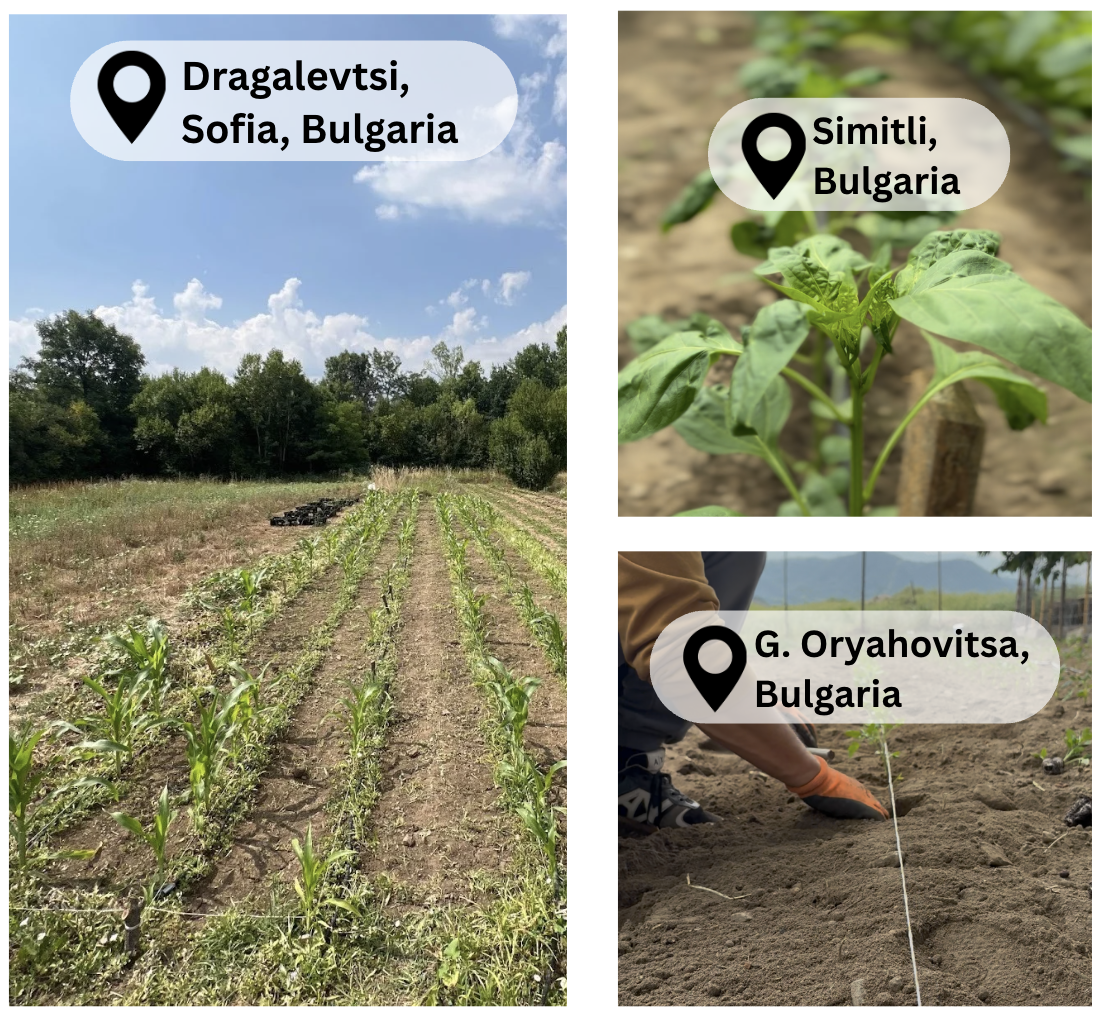
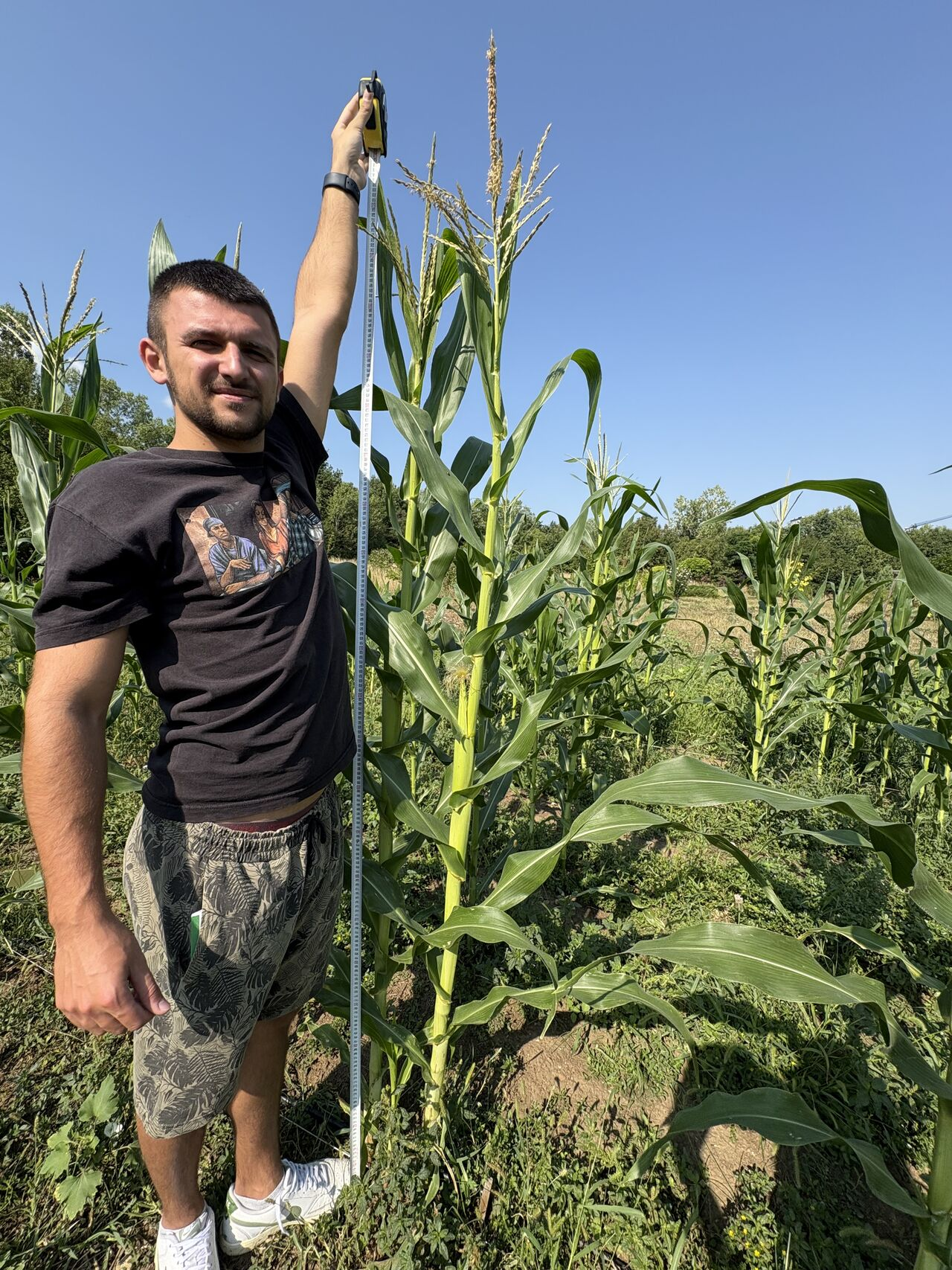
Plant trials were conducted at three locations—Dragalevtsi, Gorna Oryahovitsa, and Simitli—across different soil types and fertility levels. Baseline soil analysis was followed by custom microbial formulation and application. After 30 days, plants at all sites showed stronger color, accelerated early growth, and improved cob or fruit formation. Nutrient levels in low-fertility soils increased by approximately eight percent, confirming the effectiveness of microbial mobilization. The consistency of results across diverse locations demonstrated the feasibility of adaptive, soil-specific microbial fertigation.

Community engagement was central to the project. A storytelling approach using visual concepts helped gardeners understand how the system works and how they would interact with it. Participants found the process intuitive and expressed trust in the soil-to-biofertilizer logic. Valuable feedback included requests for larger buttons, brighter displays, and clearer visual or audio cues—insights that will directly inform the next prototype.
Looking ahead, the next phase focuses on building the first fully functional prototype of the Soil Analysis Module, complete with auto-calibration. Usability testing with hobby gardeners will refine the interface and workflow, while integration with the MDF will allow for real-time dosing in live trials. Expanded field validation across new locations and soil types will further strengthen performance data and scalability.
Through this project, Enthela demonstrates how localized biofertilizer production—powered by real-time soil sensing and microbial science—can bring the values of the New European Bauhaus directly into gardens and communities. The system is sustainable, modular, accessible, and resilient, offering a new model of neighborhood-scale, human-centric production that supports healthier soils and more responsible food cultivation.
Read more about our member Enthela here.
Tags
Related Articles
Continue reading our latest insights and updates from the AgriVentures ecosystem.

Biotechnology, Agri-Inputs and Biosecurity: Why the Future of Farming Needs a Wider Conversation in Sofia
Agriculture is undergoing a quiet transformation. Genomic tools, precision biological solutions, and new generations of crop protection and plant nutrition products are changing what is possible in the field and along the whole food chain. At the same time, the same advances raise questions that the sector is only beginning to ask. Who controls the genetic resources and seeds we depend on? How do we manage biosecurity when biological agents and genomic technologies can be used for more than...

Where Agrifood Biotech and Research Funding Is Actually Going in 2026
Basic research doesn't fund itself, and in agrifood, the gap between a promising lab result and a fundable project often comes down to knowing which of a dozen overlapping EU programmes to approach first. Food safety science, biotech platforms, and multi-country research consortia each follow their own funding logic, and 2026 has brought fresh calls across all three. Two Live Examples Worth Studying Safe-Agri, one of AgriVentures' active projects, is reinforcing the security assessment...

VerAgro launches a free self-assessment to help farms measure - and improve - their sustainability
"How sustainable is your farm?" It's a question most producers can answer instinctively, but rarely with hard numbers. A new Bulgarian startup wants to change that. VerAgro, a Bulgaria-based agtech startup, has launched a free online self-assessment that gives farms and processors a clear, structured picture of where they stand on sustainability — and what to do next. A 20-minute check-up for your farm The tool works like a health check-up for your operation. Farmers and processors answer 57...

A New Door Is Opening for Bulgarian Farmers and Agri-Innovators - And It's Fully Funded
For years, the biggest barrier between Bulgarian agriculture and Europe's most advanced farms hasn't been ambition. It's been access — to the right rooms, the right people, and the budget to get there. AgriVentures' new Missions program was built to remove exactly that barrier, and it does it in a way few programs in the region ever have: by covering the full cost of getting Bulgarian farmers, entrepreneurs, scientists, and companies in front of Europe's leading agri-food innovators. If you...

Inside projects.agriventures.co: Your Gateway to EU AgriFood Innovation
AgriVentures has launched projects.agriventures.co, a dedicated portal that brings the full portfolio of our EU-funded initiatives into one place. Where agriventures.co connects agrifood innovators with funding, the Projects site shows what happens next: the live programmes, Living Lab pilots, and network activity that funding makes possible. Here's what you'll find on the site — and how each part of our community can put it to work. A Live Portfolio of EU Projects The homepage opens with our...

Understanding Biomass Flows in Europe: A €6M Horizon Europe Call Agrifood Founders Shouldn't Miss
A question we've been getting a lot lately, including from our own LinkedIn community, is some version of: "Can my startup actually apply for this, and how?" This time it's about Understanding biomass flows in Europe (HORIZON-CL6-2026-01-CIRCBIO-05), a Horizon Europe call with a total budget of €6,000,000 that opened on 17 April 2026 and closes on 17 September 2026. It's exactly the kind of opportunity worth breaking down properly, because the honest answer is "yes, but not the way most...
Never Miss an Update
Join our community to receive the latest insights, funding opportunities, and industry news from AgriVentures.