Robotics and AI Are Reshaping Agriculture and Food Systems: From Small Farms to Self-Driving Labs and Autonomous Kitchens

Agriculture and food systems are undergoing a fundamental transformation powered by robotics, artificial intelligence, and automation. After a challenging investment cycle for agtech, recent developments indicate a shift toward highly specialized automation solutions that are scalable, cost-efficient, and commercially viable. New milestones from Naïo Technologies, Atinary, and Appetronix demonstrate the growing maturity of automation in farming, scientific research, and food service.
French agricultural robotics company Naïo Technologies has relaunched following structural and financial restructuring, supported by €6.4 million in new financing. The round includes continued investment from Mirova, Bpifrance, and the Occitanie Region’s ARIS fund.
Full details were reported by La Tribune and can be accessed here
Naïo has streamlined its innovation roadmap to focus on two flagship robotic platforms designed specifically for small and medium-sized agricultural operations: Oz, a lightweight robot for market gardening, and TED, an autonomous vineyard robot. The company aims to achieve operational profitability by 2028, scale manufacturing to 100 robots per year, and reach €11 million in annual revenue by 2030. This sharper strategic focus reflects a growing demand for automation tailored to smaller farms, a segment historically underserved due to cost and complexity barriers.

At the intersection of AI and scientific discovery, Atinary has partnered with ABB Robotics, Mettler-Toledo, and Agilent Technologies to launch one of the industry’s first fully automated, AI-orchestrated self-driving laboratories in Boston. The platform integrates machine learning and Bayesian optimization to autonomously design and execute experimental sequences, accelerating R&D cycles for novel materials and chemical formulations.
The announcement and key insights were covered by AgFunderNews and are available in full here
The implications for agrifood innovation are significant, offering the potential to dramatically shorten development timelines for biological inputs, crop protection formulations, alternative proteins, and next-generation sustainable materials.
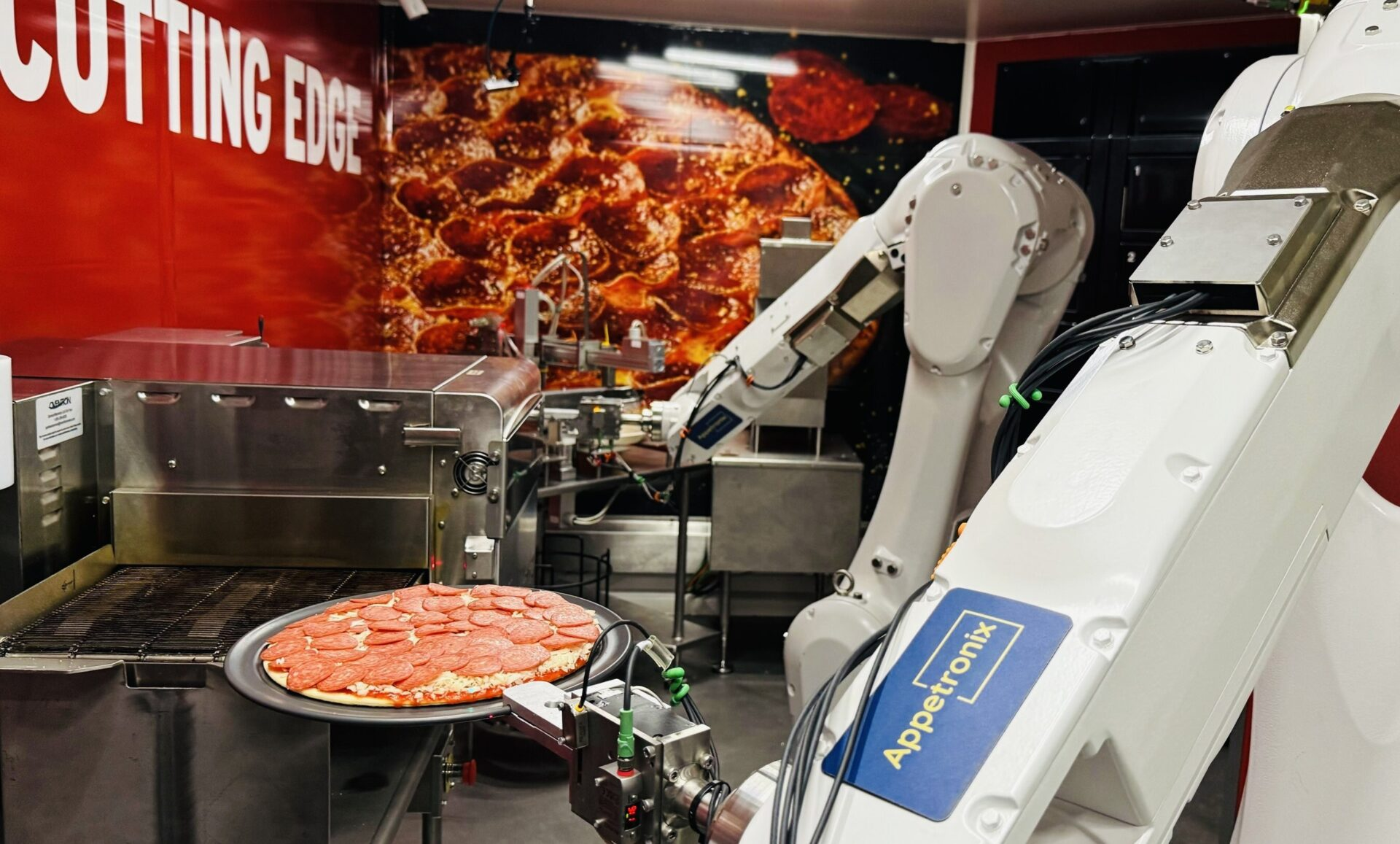
Beyond agriculture and research, automation is reshaping commercial food production. Appetronix, a Toronto-based robotic kitchen company, has raised a $6 million seed extension round, bringing its total funding to $10 million. The company’s model departs from conventional retrofitting approaches by deploying modular food production units engineered from the ground up for fully autonomous operation. The company’s recent funding announcement and product overview were reported by TechCrunch, available here
Appetronix has launched its first commercial robotic pizza kitchen in partnership with Donatos Pizza at Columbus International Airport, operated by HMSHost. Its systems leverage the Viam automation platform for real-time food monitoring, process control, and predictive system maintenance. Instead of selling hardware units, Appetronix deploys a revenue-sharing model, with projected per-unit annual revenues between $750,000 and $1.5 million. The company plans to extend deployments across airports, universities, hospitals, and other high-traffic venues while scaling manufacturing capabilities in Asia.
Collectively, these developments reflect structural changes shaping the future of agrifood systems. Automation is becoming financially accessible for smaller farms, R&D systems are transitioning to autonomous, data-driven discovery models, and food preparation is shifting toward scalable, factory-style food production systems rather than human-replicating robotic tasks.
For emerging innovation ecosystems such as those supported by Agriventures, these advancements reinforce a critical trajectory: the future competitiveness of food systems will not be driven by automation alone, but by automation that is economically viable, modular, scalable, and purpose-built for real-world deployment.
Tags
Related Articles
Continue reading our latest insights and updates from the AgriVentures ecosystem.

Biotechnology, Agri-Inputs and Biosecurity: Why the Future of Farming Needs a Wider Conversation in Sofia
Agriculture is undergoing a quiet transformation. Genomic tools, precision biological solutions, and new generations of crop protection and plant nutrition products are changing what is possible in the field and along the whole food chain. At the same time, the same advances raise questions that the sector is only beginning to ask. Who controls the genetic resources and seeds we depend on? How do we manage biosecurity when biological agents and genomic technologies can be used for more than...

Where Agrifood Biotech and Research Funding Is Actually Going in 2026
Basic research doesn't fund itself, and in agrifood, the gap between a promising lab result and a fundable project often comes down to knowing which of a dozen overlapping EU programmes to approach first. Food safety science, biotech platforms, and multi-country research consortia each follow their own funding logic, and 2026 has brought fresh calls across all three. Two Live Examples Worth Studying Safe-Agri, one of AgriVentures' active projects, is reinforcing the security assessment...

VerAgro launches a free self-assessment to help farms measure - and improve - their sustainability
"How sustainable is your farm?" It's a question most producers can answer instinctively, but rarely with hard numbers. A new Bulgarian startup wants to change that. VerAgro, a Bulgaria-based agtech startup, has launched a free online self-assessment that gives farms and processors a clear, structured picture of where they stand on sustainability — and what to do next. A 20-minute check-up for your farm The tool works like a health check-up for your operation. Farmers and processors answer 57...

A New Door Is Opening for Bulgarian Farmers and Agri-Innovators - And It's Fully Funded
For years, the biggest barrier between Bulgarian agriculture and Europe's most advanced farms hasn't been ambition. It's been access — to the right rooms, the right people, and the budget to get there. AgriVentures' new Missions program was built to remove exactly that barrier, and it does it in a way few programs in the region ever have: by covering the full cost of getting Bulgarian farmers, entrepreneurs, scientists, and companies in front of Europe's leading agri-food innovators. If you...

Inside projects.agriventures.co: Your Gateway to EU AgriFood Innovation
AgriVentures has launched projects.agriventures.co, a dedicated portal that brings the full portfolio of our EU-funded initiatives into one place. Where agriventures.co connects agrifood innovators with funding, the Projects site shows what happens next: the live programmes, Living Lab pilots, and network activity that funding makes possible. Here's what you'll find on the site — and how each part of our community can put it to work. A Live Portfolio of EU Projects The homepage opens with our...

Understanding Biomass Flows in Europe: A €6M Horizon Europe Call Agrifood Founders Shouldn't Miss
A question we've been getting a lot lately, including from our own LinkedIn community, is some version of: "Can my startup actually apply for this, and how?" This time it's about Understanding biomass flows in Europe (HORIZON-CL6-2026-01-CIRCBIO-05), a Horizon Europe call with a total budget of €6,000,000 that opened on 17 April 2026 and closes on 17 September 2026. It's exactly the kind of opportunity worth breaking down properly, because the honest answer is "yes, but not the way most...
Never Miss an Update
Join our community to receive the latest insights, funding opportunities, and industry news from AgriVentures.